
Harmonic Frequencies
Musical sounds consist of a fundamental frequency, harmonics, and overtones. Discover how these elements combine to create rich, captivating music.
Fundamental Frequency
The lowest frequency of any vibrating object is called the fundamental frequency. The fundamental frequency provides the sound with its strongest audible pitch reference - it is the predominant frequency in any complex waveform.
A sine wave is the simplest of all waveforms and contains only a single fundamental frequency with no harmonics or overtones.

Virtually all musical sounds have waves that are infinitely more complex than a sine wave. It is the addition of harmonics and overtones to a wave that makes it possible to distinguish between different sounds and instruments; this is known as the timbre.
Harmonics
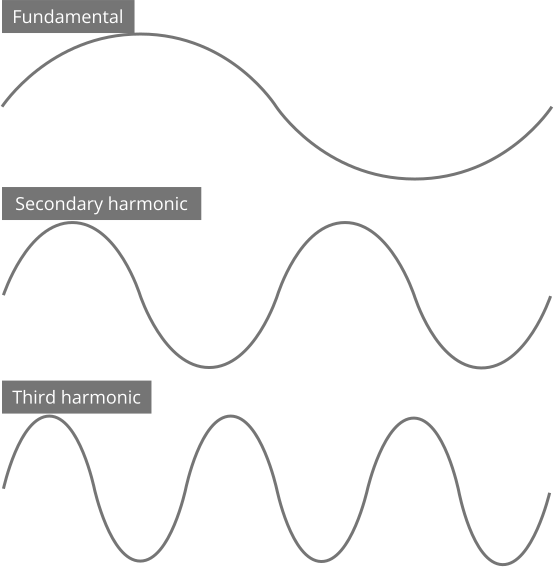
A harmonic is one of an ascending series of sonic components that sound above the fundamental frequency.
The higher-frequency harmonics that sound above the fundamental make up the harmonic spectrum of the sound. Harmonics can be difficult to perceive distinctly as single components, but they shape the overall texture.
Harmonics generally have a lower amplitude than the fundamental frequency.
Harmonics are integer multiples of the fundamental frequency. For example:
- The fundamental frequency is 50 Hz (also known as the first harmonic).
- The second harmonic is 100 Hz (50 × 2 = 100 Hz).
- The third harmonic is 150 Hz (50 × 3 = 150 Hz), and so on.
Overtones
Overtones are frequencies present in a waveform that are higher than, but not necessarily strict integer multiples of, the fundamental frequency.
Resulting Timbre
Two tones produced by different instruments might have the same fundamental frequency and thus the same perceived pitch (e.g., a middle C note), but they will sound very different because of the presence of differing amounts and types of harmonics and overtones.
It is the presence and relative strength of harmonics and overtones within a sound wave that define its unique character.
The timbre describes those qualities of a sound that allow the human ear to distinguish between two sounds that share the exact same fundamental pitch.
Timbre is why a piano playing C3 sounds radically different from an acoustic guitar plucked at C3. Because timbre is subjective, it is often described using descriptive terms such as reedy, warm, brassy, or golden.
Understanding harmonics and timbre is essential when using equalizers to either enhance an instrument's natural tone or carve out competing frequencies in a mix.