
Expander
An expander is an audio processing tool that functions opposite to a compressor, activating when the signal falls below a set threshold. By increasing the dynamic range of a signal, expanders enhance clarity and definition in audio recordings. Learn how to utilize expanders for improved sound quality.

Benefits of Using Expanders
Expanders can effectively replace noise gates in many mixing scenarios, offering a much more subtle and transparent downward dynamic effect. Unlike noise gates, which can create a sharp, jarring digital cut-off when the signal drops past the threshold, the gradual slope of an expander results in a smooth, natural transition.
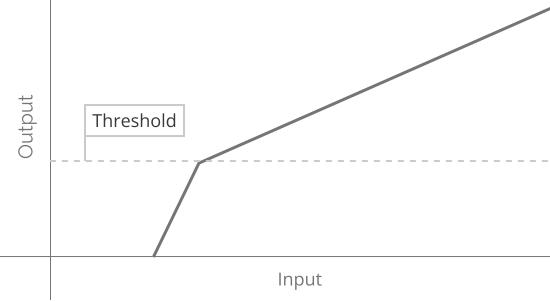
Expansion Ratio
The expansion ratio is the mathematical inverse of a compression ratio. For example, while a compressor operates at ratios like 4:1 to control loud peaks, a downward expander operates at a ratio such as 1:4.
This means that for every 1 dB the input signal drops below the threshold, the output level decreases by 4 dB. By expanding the dynamic range rather than squashing it, low-level background noise and leakage are cleanly attenuated without sounding unnatural.
Downward expanders are often referred to as "soft gates." Because they scale attenuation proportionally rather than muting audio entirely, they are an exceptional tool for smoothing out bleed on tracks like overheads, tom drums, and acoustic guitars.