
Sound Envelopes
The envelope of a sound displays how the level of a sound wave changes over time. Learn how to analyze sound envelopes and enhance your sound design skills.
The envelope of a wave helps establish a sound's unique individual quality, exerting a significant influence on how we interpret and perceive timbre and dynamics.
Signal Envelope
The envelope of a sound can be measured in four distinct phases (ADSR):
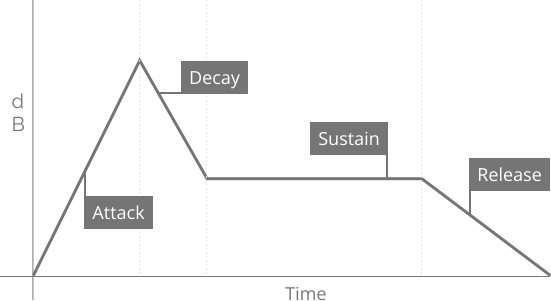
Attack: The attack represents the time taken for the amplitude to reach its maximum level. Essentially, it is the initial build-up or onset of a sound.
Decay: The decay is the progressive reduction in amplitude immediately following the peak of the attack phase. During decay, the signal level drops until it stabilizes at the sustain level.
Sustain: The sustain is the period of time during which the sound's amplitude is held constant while energy continues to be applied. Many percussive instruments do not contain a sustain phase.
Release: The release is the final fade or reduction in amplitude down to silence once the sound source stops receiving energy.
On synthesizers and processors, the ADSR envelope is typically controlled via a set of dedicated knobs, sliders, or graphical software parameters.

Differing Sounds
Every instrument has a unique envelope profile. Percussive sounds start suddenly with a fast attack, then decay and release quickly because no ongoing energy is applied to sustain them.
A bowed string instrument, on the other hand, may build up with a slow attack, sustain for as long as the bow moves across the string, and then release gracefully.
Most natural sounds decay higher frequencies faster than lower frequencies because high-frequency acoustic energy is dissipated into the air and surrounding environment much more rapidly.
Hearing Envelopes
Our perception of a sound's envelope and loudness relies heavily upon root-mean-square (RMS) values of amplitude rather than instantaneous peak-to-peak amplitudes.
Extremely short, sharp peaks in a signal will not necessarily make an instrument sound loud unless that amplitude is sustained over a period of time. Instead, short transients tend to contribute heavily to the distinct timbre (character) of the sound rather than its perceived overall loudness.
Mastering how ADSR envelopes work is vital when configuring compressors, limiters, and gates to shape the transient response and punch of your mixes.